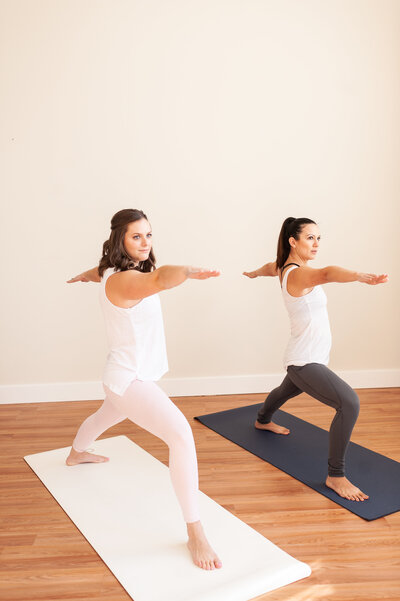
Most people who show up to their first Christian yoga class are braced for something gentle and simple. They expect a few stretches, maybe a scripture reading, and an easy hour. By the end, they’re usually surprised by how much actually happened and how much of it had nothing to do with flexibility.
That surprise is worth explaining, because it keeps people away who would genuinely benefit, and it also sets up the wrong expectations for people who do show up.
The Pacing Is Intentional, and That’s What Makes It Hard
This is probably the most consistent thing we hear from new participants: they expected it to be a relief and found instead that it required more concentration than they’d anticipated.
In a typical fitness yoga class, movement gives you somewhere to put your attention. You’re tracking the next pose, keeping up with the group, managing effort. The pace creates a kind of cognitive busyness that, honestly, functions as a form of distraction.
Christian yoga classes deliberately remove that distraction. Poses are held longer. Transitions are deliberate. There’s more silence. And what fills that silence is the actual work: noticing where your body is bracing, where your breathing has gone shallow, and what your mind is doing with stillness.
Physiologically, holding a pose for 45 seconds to two minutes shifts the demand from coordination to endurance. The muscles involved aren’t just contracting and releasing; they’re sustaining. That’s a different kind of effort. The nervous system, rather than being occupied with what’s coming next, has to settle into what’s happening right now.
This is where the spiritual dimension and the physical one stop being separate categories. Stillness is a discipline. Paying attention is a discipline. For people whose lives are full of noise and obligation, being asked to stay present without rushing forward can feel genuinely uncomfortable in the first few classes.
That discomfort is useful. It’s often where the most meaningful work begins.
What “Christ-Centered” Actually Shapes in a Class
It’s worth being specific here, because vague phrases like “faith-integrated” tend to make people either skeptical or confused.
In a Christ-centered yoga class, the movement, the breath, and the scriptural focus are chosen together, for each other.
A class might center on a single passage from Philippians or Psalms. The physical practice builds around the same theme: grounding poses during a reflection on steadiness, opening postures during a reading about release or surrender. The breath cues aren’t neutral technique instructions; they’re invitations toward a particular kind of attention.
This is meaningfully different from a standard yoga class that opens with a blessing. The theological frame here actually informs the structure of the experience. If you want to understand what Christ-centered yoga looks like in practice, the framing of mind, body, and spirit as integrated rather than separate is the core of it.
For people with a genuine faith practice, this integration tends to feel clarifying rather than jarring. For people who are faith-curious but uncertain, it often opens something up rather than closing it down. What we don’t find is that it’s theologically demanding in a way that requires any particular level of biblical literacy. The entry point is honest attention, not doctrinal fluency.
The Body-Mind Connection People Weren’t Expecting to Work On
Many people who come to Christian yoga classes are dealing with something beyond general fitness goals. They’re carrying anxiety, grief, chronic stress, or a vague sense of being disconnected from themselves. They’ve sometimes tried talk therapy, or they’re in therapy alongside this, and they’re looking for something that works differently.
The way yoga addresses stress and anxiety through the body rather than just the mind is genuinely distinct from other interventions, and it’s worth taking seriously. Slow, sustained movement with intentional breath activates the parasympathetic nervous system. Not in a metaphorical sense. The physiological shift is measurable: heart rate slows, breath deepens, and the body’s threat response begins to ease.
What Christian yoga adds to this is a reason for it that goes beyond technique. The calming isn’t just optimization. It’s a form of trust. Releasing physical tension becomes connected to releasing the need to control. That reframe matters to people whose anxiety is partly theological: the fear of getting things wrong, the weight of self-sufficiency, and the difficulty of rest.
We see this show up in participants who describe feeling guilty for not being productive or who find genuine stillness almost intolerable at first. The class structure holds them in it, gently, without force, and over several weeks something tends to shift. The relationship between a healthy body and a healthy mind is something we take seriously here, and Christian yoga is one of the clearest places we see that connection become tangible for people.
Who Actually Belongs Here (the Answer Is Broader Than You’d Think)
The people in our Christian yoga classes are not a homogeneous group. On any given day, the room includes someone recovering from burnout, someone navigating a loss, someone whose doctor said they needed to manage their stress better, someone who’s been a regular churchgoer for decades, and someone who grew up religious and is still figuring out what they believe.
What they share isn’t theological agreement. It’s a willingness to be in their bodies, to be present, and to let something spiritually grounded shape that presence.
We do occasionally get questions about whether traditional yoga and Christian practice are compatible, and it’s a real question worth taking seriously rather than waving away. Our own thinking on that is shaped by where we’ve landed after years of practice: the movement and the breath are carriers of whatever intention and attention you bring to them. In our classes, that intention is explicitly Christian. The postures serve the practice; the practice serves something larger.
People who’ve been told by their church that yoga is problematic sometimes come anyway, curious. People who’ve never set foot in a church and want a quieter, more reflective movement class also come. Both groups usually find what they were actually looking for.
If you’re wondering whether anxiety or chronic stress is part of what’s driving your interest in a class like this, that’s worth paying attention to. Christian yoga can be a meaningful part of addressing those patterns, though for more persistent or significant anxiety, it works best alongside other support.
Before You Sign Up, One Thing to Know
The classes will ask more of you than you’re probably planning for. In a paying-attention way.
Show up with comfortable clothes, a willingness to move slowly, and no particular agenda for what you’re supposed to feel at the end. The people who get the most out of it are usually the ones who come in uncertain rather than the ones who’ve already decided what they think it is.
The first class is usually eye-opening. The third or fourth is usually when something starts to settle. If you want to know more about what we offer or whether it fits what you’re looking for, reaching out is the most straightforward next step.