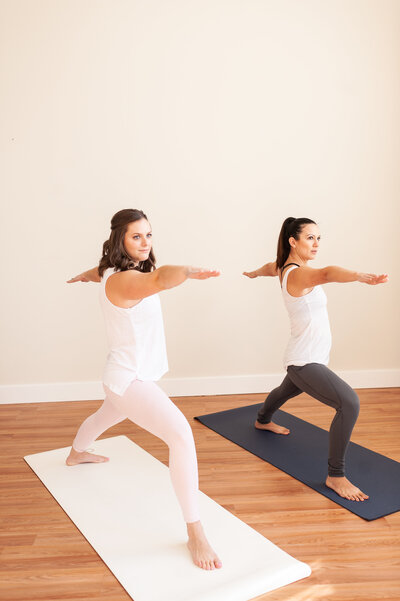
Most people who search for Christian yoga near them are carrying a quiet version of the same question: Is this actually okay for me to do? That hesitation makes sense. The word “yoga” pulls in one direction for many Christians, and the word “Christian” pulls in another. What actually happens in a Christ-centered yoga class sits somewhere more specific and more grounded than either assumption.
At Graceful Balance Wellness, we see what that hesitation costs people. Someone manages chronic anxiety for months without any physical outlet that feels spiritually safe. Someone else avoids yoga entirely because they’re not sure what they’d be agreeing to. So let’s be plain about what this practice is, what it’s not, and why the people who show up for it tend to stay.
What People Assume (and Why That Assumption Keeps Them Away)
The most common picture people have of Christian yoga is one of two things: a regular yoga class with a Bible verse tacked onto the end, or a strange hybrid that feels half-hearted about both traditions. Neither of those is accurate, and neither of those is what people need.
Christ-centered yoga treats the body as something God made and intends to be cared for, not a vessel to be transcended or emptied. The movement, the breathwork, the stillness at the end of a session: all of it is reoriented toward the person of Christ rather than toward a neutral or Eastern spiritual framework. This is not about removing the Eastern roots and hoping nobody notices. It’s about offering a genuinely different theological grounding from the start, one where the body’s involvement in worship and healing is already a biblical idea.
When someone walks in carrying tension across their shoulders that they’ve carried for years, or when their chest tightens every time their mind goes to a particular fear, the question “where do I put this body of mine in relation to my faith?” is not a small one. Christian yoga is one of the few spaces that takes both sides of that question seriously at the same time.
What Actually Happens in a Session
The structure of a Christ-centered yoga class at Graceful Balance looks more like a guided practice in embodied prayer than a workout. Sessions typically begin with breath focus and scripture, not as an add-on but as the actual starting point for what the body is about to do. Movement follows, and the cues are explicit about what each posture is an opportunity for: releasing, receiving, and resting in.
What that looks like practically:
- Breath work that connects the body’s natural calming response to the biblical concept of the Spirit (ruach, breath, wind) as present and active
- Movement sequences paced to encourage awareness rather than performance, so a person whose anxiety tends toward hypervigilance has somewhere to practice slowing down that isn’t just sitting still
- Rest postures that create space for quiet prayer without the pressure of “doing it right”
The research on yoga’s effect on the nervous system is well-documented elsewhere. What’s less often named is why the spiritual framing of that same movement can produce a different quality of engagement for someone who is also doing inner healing work. When the movement is held in a framework you already trust, you give your nervous system permission to settle in a way that’s harder to access when you’re halfway monitoring whether the spiritual environment is safe. This is something we see consistently in our clients who combine Christ-centered yoga with counseling.
The connection between yoga, stress, and anxiety is something we’ve written about in more depth if you want to understand more about what the body-based piece of this actually does.
Who This Is Actually For
Christian yoga works for a wide range of people, but the ones who tend to benefit most have something specific in common: they’ve been trying to manage what’s happening internally through thinking alone.
Someone with high-functioning anxiety often presents to us looking entirely composed. They’ve read the books. They can identify their cognitive distortions. They know the breathing techniques in theory. What they haven’t done is practice those techniques in a body that’s been trained to hold still and perform, because that’s how they’ve survived. Christian yoga gives them a context where the body is invited to participate in something that matters, without the performance metric.
Others come because they feel disconnected from their faith, not intellectually but physically. Prayer feels flat. Worship feels distant. They wonder if something is wrong with them spiritually, when often what’s happened is that the connection between the physical and the spiritual has gone quiet. Bringing the body back into the practice of faith is sometimes exactly what opens that up again.
A few common situations we see:
- Adults managing anxiety or stress who want an outlet consistent with their faith
- People in counseling who want a body-based complement to talk therapy
- Women postpartum who need gentle movement paired with spiritual grounding
- Anyone who tried regular yoga and felt spiritually unsettled by it
We don’t require any prior yoga experience. A willingness to show up is enough.
Why the Spiritual Framework Is the Point, Not the Garnish
Christian yoga is something more specific than yoga made more palatable for church-goers.
The specific framework of faith changes what the body does with the experience. When someone moves through a posture while holding a verse about being held or breathes through a posture while naming what they want to release to God, the cognitive and somatic experiences are happening together. That’s not incidental. That’s the mechanism.
Counselors who understand the mind-body connection know that you can’t have genuine mental health without attending to the physical. Christian yoga adds a third layer: the spiritual self is part of the process. For someone whose faith is central to who they are, that integration produces something that neither a secular yoga class nor a Sunday morning alone would give them.
This is also why people searching for Christian yoga near them often find that what they were really looking for was a practice, not just a class. Something repeatable, grounding, and genuinely theirs.
Finding the Right Fit Before You Commit
If you’re looking for Christian yoga near you and you’ve landed here, a few things worth knowing before you book anything:
Ask whether the instructor has training in both the physical practice and the spiritual integration, not just one. A personal trainer who added scripture slides is different from someone who has thought carefully about how movement and faith interact and can articulate why.
Ask whether the class connects to any broader support, counseling, or wellness resources. Christian yoga is a powerful standalone practice, but it works best for people dealing with anxiety, trauma, or relational stress when it’s part of a broader picture of care. At Graceful Balance, our yoga offerings sit within a clinical wellness context, which means if something comes up in a session that needs more than movement to work through, you’re already in the right place.
And give it more than one session. The first class is often about just figuring out where to put your hands. The second is when people start to feel what this is actually for.
If you want to talk through whether Christian yoga is a good fit for where you are right now, reach out to us directly. We’re glad to help you figure out what kind of support makes the most sense.